
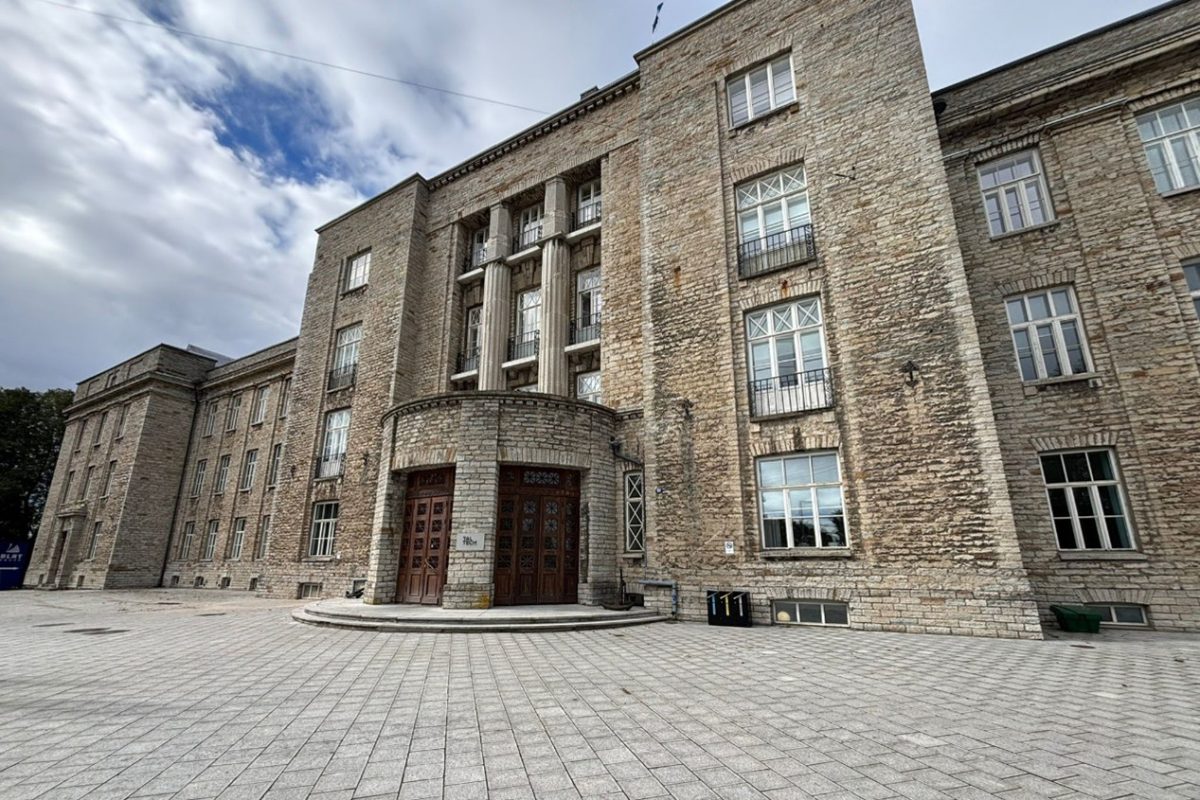
The 21st Maritime Conference, held in Tallinn in late September 2025, brought together industry experts, researchers, and policymakers to consider the future of European maritime transport. The event provided an overview of the latest developments in the green transition, digitalization and geopolitical changes reshaping the maritime domain, as well as exploring ways in which Estonia and other EU countries (e.g. Finland) can strengthen their cooperation in these areas.
TalTech, the Estonian maritime cluster, and the perspective of preparedness
A visit to the Estonian Maritime Academy at Tallinn University of Technology (TalTech) offered valuable insight into the university’s maritime education and, the activities of the Estonian maritime cluster. TalTech curriculum covers the full spectrum of maritime competencies: from navigation and marine engineering to port operations, shipping management, and waterway safety. The strength of the Estonian maritime cluster lies in its ability to integrate education, research, and industry into a shared development platform that enhances both competitiveness and societal preparedness. The development of the Estonian maritime sector is increasingly being viewed through the lens of national security and resilience. Considering the evolving geopolitical landscape in the Baltic Sea region, the importance of maritime transport is recognized not only in economic terms, but also as part of critical infrastructure (Nõmmela, 2023). This perspective is particularly relevant in Finland, where similar questions arise regarding how to ensure the safety and sustainability of maritime operations in changing conditions.
European maritime transport in transition
Discussions at the conference emphasised that European maritime transport is undergoing a profound transformation. The green transition and ambitious emissions reduction targets are major drivers of this change. However, it is important to strike a balance between environmental goals, cost structures and competitiveness (Finnish Shipowners’ Association, 2025).
Digitalization and artificial intelligence (AI) offer new possibilities for improving efficiency and safety. Automated data exchange, advanced analytics, and AI-assisted decision-making are increasingly embedded in maritime operations, with their strategic importance expected to grow even further.
From a macroeconomic perspective, the economic uncertainty in Europe and the disruptions to the global supply chain have direct implications for maritime transport, emphasising the need for flexibility and the ability to adapt quickly.
The role of technology, green fuels, and ports
Adopting emerging technologies and green solutions was a core theme throughout the event. Ports are increasingly being recognised as hubs for innovation and energy transformation. They are expected to support the green transition by providing the necessary infrastructure for alternative fuels and smart energy systems (Hrenov et al., 2025). Meanwhile, the decarbonisation strategies of shipping companies directly influence future port investments.
However, technology alone cannot drive the transition. The move towards low-emission solutions requires the collaboration of shipping companies, ports, authorities and the research community. State-level support was identified as crucial for all stakeholder groups. The success of maritime transport relies on shared goals and open information exchange within its complex, multilayered ecosystem.
Common challenges, common solutions
Like their Finnish counterparts, Estonian maritime stakeholders face many of the same challenges:
- how to advance the green transition without compromising competitiveness,
- how to prepare for geopolitical risks and supply-chain disruptions, and
- how to attract new talent to a sector undergoing rapid transformation.
These shared challenges mean that cooperation between Finland and Estonia is not only natural, but also necessary. The two countries have complementary strengths: Estonia contributes agility and quick decision-making, while Finland has a strong tradition of research collaboration and digital development. Together, these strengths could promote sustainable growth and security throughout the Baltic Sea region.
The NEMO project and the future direction
The conference also presented a valuable opportunity to promote the NEMO project and its objectives of encouraging digitalisation, intelligent transport and international collaboration. From NEMO’s perspective, the event reinforced the importance of technological solutions, open data, and cross-border collaboration for the future of maritime transport.
One of the key messages from Tallinn was that the future of maritime transport cannot be developed in isolation. Rather, it will emerge through networks, shared objectives, and collective responsibility. As the green transition, technological advancement and security considerations converge, maritime transport has the potential to drive Europe’s sustainable growth and resilience.
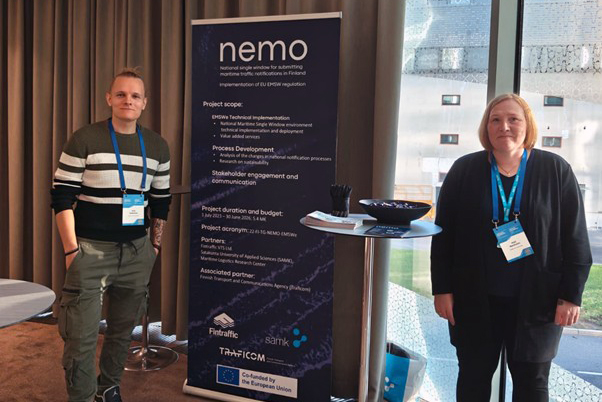
The authors Wili Helenius and Kati Renholm work as researchers at the Maritime Logistics Research Center at SAMK.
They are at NEMO’s stand at the event in the photo.
References:
Hrenov, G., Järvis, M. & Reinhold, K. (2025). Decarbonizing Port Operations: A Case Study Mapping the Sustainability Impacts of Green Ammonia Production and Bunkering in Estonia. Research Publishing. DOI: 10.3850/978-981-94-3281-3_ESREL-SRA-E2025-P4969-cd.
Nõmmela, K. (2023). Enhancing Sustainable Development of the Estonian Maritime Sector through Policy-making Framework. [Doctoral thesis, Tallinn University of Technology]. ISBN 978-9949-83-965-0 (PDF)
Suomen Varustamot ry. (8.12.2025). Uusi kannustin meriliikenteen vähäpäästöisille polttoaineille voisi tuoda miljardiluokan hyödyt Suomelle.
Translation was made from Finnish to English using DEEPL.
The photos: Wili Helenius and Kati Renholm (the header photo features Tallinn University of Technology).